
Manufacturers across many industries stand behind their products with some form of warranty. Whether it covers a material defect in a shirt or blouse, the need to replace a tool or a kitchen appliance, or the servicing of a complex piece of equipment, the goal is the same: provide a clear and easy process for repairing or replacing products when something goes wrong.
How those warranties look can be very different. Some manufacturers simply replace a failed product, while others must track individual units in the field, manage replacement parts, or support technicians servicing that equipment. The process itself can also vary. Customers, dealers, or installers may register products online, submit claims through a portal, or call a support “hotline” to report a failure and request replacement parts.
Despite these differences, every warranty process depends on the same foundation: accurate product records. Manufacturers must know what was sold, who owns it, and what components are tied to that item or unit when a claim is submitted.
Simply putting a form online doesn’t solve any of those problems. If every registration or claim still requires someone to manually confirm serial numbers, verify ownership, or look up product details, the process quickly turns into a larger “digitized” paper trail. Any real value comes from connecting the warranty registration, claims, replacement parts workflows to accurate product and sales data tied to a specific item or unit.
Warranty Management Systems May Not Be the Answer
Many manufacturers address warranty registration and claims by purchasing a dedicated warranty management system. If that system is not integrated with the ERP at all then your team is left manually verifying what was sold, confirming ownership, and manually tying claims back to the correct product and customer records in the ERP.
If the warranty management system is integrated, a different challenge emerges. That integration becomes another thing that must be maintained so that serial and model numbers, orders, and customer and service data stays synchronized between systems and everything stays aligned.
Either way, additional systems mean additional complexity—either through manual processes or through additional layers of integration.
Nomad eCommerce takes a different approach. Our platform supports warranty registration, claims, ownership transfers, part lookup and ordering, and product documentation natively, so manufacturers and distributors do not have to rely on a separate warranty system to support those workflows online.
That also means warranty activities can live in the same place customers, dealers, distributors, and service partners already go to interact with your products—whether they are checking details, accessing documentation, or ordering replacement parts.
Entertech Global Brings Warranty Management into eCommerce
Enertech Global, a manufacturer of geothermal heat pump systems, provides a good example of how Nomad’s unified approach can support both product sales and post-sale service.
Through Enertech’s dealer and support site, distributors, technicians, and—in some cases—customers can:
- Register installed units
- Transfer warranty ownership
- Reorder replacement parts
- View previously purchased units
- Access technical bulletins
- See pricing updates and lead times on replacement parts
Rather than directing users to multiple systems (and logins)—or requiring calls into a help desk—these capabilities are available through a single site connected directly to Enertech’s backend data. This allows Enertech to deliver a complete view of product, warranty, and parts information without maintaining separate platforms.
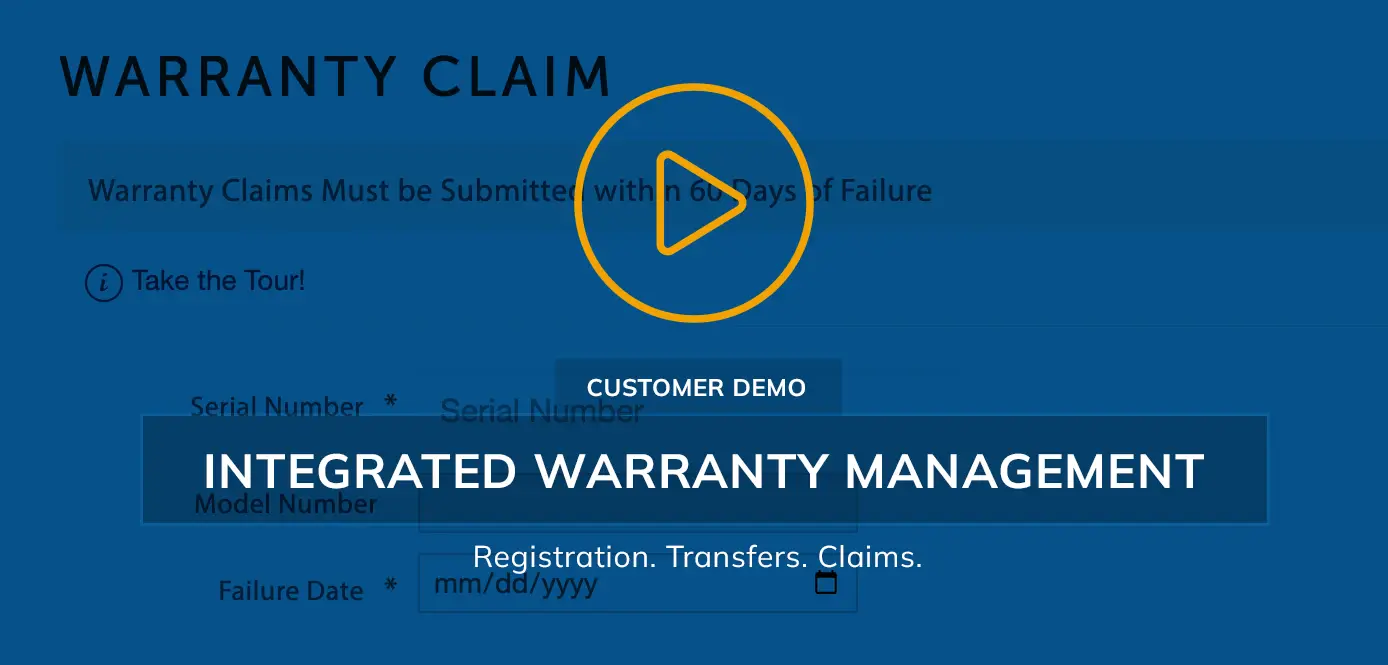
Serial Number–Driven Warranty Registration and Ownership Transfers
To register the unit, an installer (or customer) logs in and opens the warranty registration form.
Once the serial number is entered, the Nomad platform checks Enertech’s backend systems—including the original bill of materials and purchased unit records—to locate the unit. The system can automatically populate key product details (pulling that information in from the ERP) to eliminate common data-entry errors like transposed digits while speeding up the registration process.
From there, Enertech has the user complete the remaining details, including installation date, purchaser, commercial or residential designation, and technician information.*
*NOTE: Additional data points can be captured based on the manufacturer’s requirements.
Because the serial number is validated against backend records, the process ensures the unit being registered matches what was originally sold while reducing the need for manual verification.
If ownership changes in the future, that same serial-number-based workflow allows the unit to be reassigned to a new owner quickly, keeping records aligned over time.
Guided Warranty Claims
If a unit fails, a warranty claim can be initiated with the same serial number used during registration.
Once entered, the Nomad platform checks the manufacturer’s backend systems to confirm the unit’s details and associated warranty coverage. The user can immediately view warranty status and any existing or pending claims tied to that unit.
From there, the technician records the details of the claim, including the date of failure and any relevant failure codes. They can provide contact and homeowner information, specify shipping details for replacement parts, and include notes or special handling instructions.
Supporting documentation can also be uploaded directly into the portal, including images of the broken part.
Because the workflow is tied to the unit’s serial number and connected to product records, users can submit claims, request replacement parts, and document any/all issues without switching between systems or picking up a phone.
Conclusion and a Step Forward
Enertech’s approach highlights what is possible when warranty management capabilities live directly in your eCommerce platform. Registration, ownership transfers, claims, and parts access all operate in the same environment where customers, distributors, and service partners already interact with your products—without introducing another system that must be maintained and synchronized with the ERP.
To see how this works in practice, explore the Enertech Global customer story or learn more about how Nomad supports warranty management as part of a unified eCommerce platform for manufacturers.